
Embark on a transformative learning journey in Azure Data Engineering, where you will delve into the core principles, tools, and best practices for designing and implementing robust data solutions in the Azure cloud. This comprehensive guide is structured into five milestones, each carefully crafted to build your expertise progressively over six months. Whether you’re a beginner or an experienced data professional, this guide will empower you with the skills needed to excel in the dynamic field of Azure Data Engineering
Five Milestones Approach(5 Months Challenge)
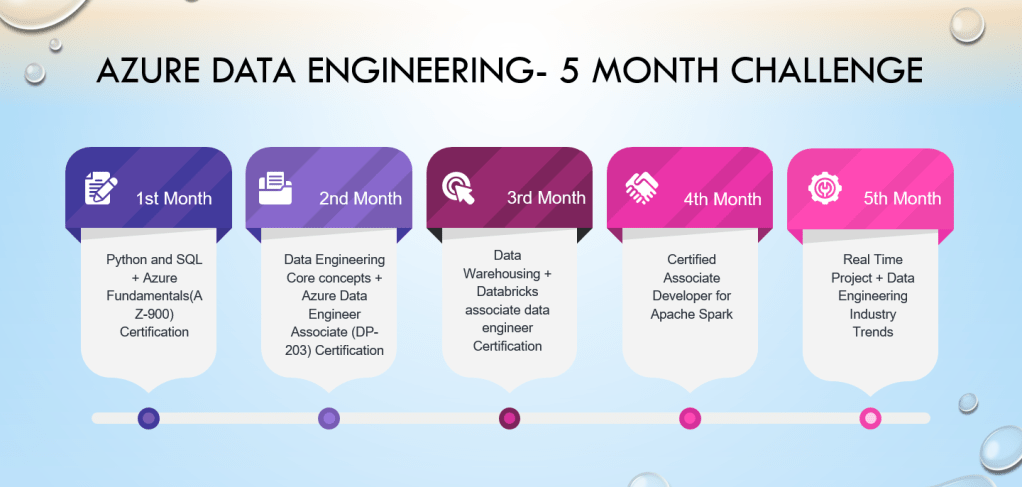
Milestone 1: Python and SQL + Azure Fundamentals(AZ-900) Certification
Python
Why Learn
Python’s versatility and readability simplify code development. Its rich ecosystem of libraries, like Pandas and Apache Spark, empowers data manipulation and analysis. Python’s scripting capabilities automate tasks, and its integration with big data technologies ensures relevance in modern data engineering workflows, meeting the demands of the job market.
What to Learn
- Basic Python Syntax: Understand the fundamentals of Python, including variables, data types, control structures (if statements, loops), functions, and exception handling.
- Data Structures: Learn about Python’s data structures such as lists, tuples, sets, and dictionaries, and understand how to manipulate and work with them efficiently.
- Libraries for Data Manipulation and Analysis: Become familiar with libraries like Pandas and NumPy for efficient data manipulation, cleaning, and analysis.
- Regular Expressions: Understand how to use regular expressions for pattern matching and data extraction, which is often crucial in data engineering tasks.
- Error Handling and Debugging: Acquire techniques for debugging Python code and implementing effective error handling to ensure robust and reliable data engineering workflows.
- Testing and Unit Testing: Familiarize yourself with testing principles and practices, including unit testing, to ensure the reliability of your code.
Where to Learn From
Optional Read: Data Engineering With Python – Paul Crickard
SQL
Why Learn
SQL is pivotal for data engineers because it provides a standardized language to interact with databases, allowing efficient data retrieval, manipulation, and management. Its role is fundamental in developing Extract, Transform, Load (ETL) processes and ensuring seamless integration of data within diverse data engineering workflows. Mastery of SQL enhances a data engineer’s ability to handle and transform data effectively.
What to Learn
- Basic Queries and Filtering: Learn foundational SQL queries, including data retrieval, filtering, and sorting.
- Joins and Relationships: Understand different join types to combine data from multiple tables and grasp relational database concepts.
- Aggregation and Summarization: Master aggregate functions for summarizing data, such as COUNT, SUM, AVG, MIN, and MAX.
- Subqueries and Nesting: Explore the use of subqueries for more complex and flexible data retrieval.
- Database Optimization: Gain skills in indexing for query performance and understanding normalization principles for efficient database design.
- Advanced SQL Concepts: Familiarize yourself with transactions, views, stored procedures, functions, triggers, and security aspects for comprehensive database management.
Where to Learn From
Azure Fundamentals(AZ-900)
Why Learn
AZ-900 is crucial for data engineers because it equips them with fundamental knowledge of Microsoft Azure, enabling effective utilization of Azure’s data storage solutions, big data processing tools, and integration services. This certification also covers key aspects like scalability, cost management, security, and compliance, making data engineers well-prepared to design and manage robust and efficient data solutions in the Azure cloud environment.
What to Learn
Where to Learn From
Milestone 2: Data Engineering Core concepts + Azure Data Engineer Associate (DP-203) Certification
Data Engineering Core concepts
Why Learn
Gives you idea about what actually a Data Engineer does on day to day basis and what concepts are his/her core strengths. With this you will understand what are the key roles and responsibilities of Data Engineer
What to Learn
- Big Data Concepts: Understand Structured, Unstructured and Semi Structured Data. Understand Distributed Processing and Storage. Also some Basics of Hadoop would be helpful(Optional). Known about 6 Vs of Bigdata (Volume, Velocity, Variety, Veracity, Value,Variability)
- File Formats : Know about few important file formats like parquet, json, avro, orc csv. Please note parquet is the most used in recent times for processing Big Data
- Pipelines and Frameworks: Data pipelines is the end to end data flow from Source till target along with multiple hops of layers like staging, raw, transform(Bronze, Silver and Gold as per medallion architecture ). Also know about Ingestion, Auditing, scheduling Alerting like Frameworks(Optional)
Where to Learn From
Azure Data Engineer Associate (DP-203) Certification
Why Learn
- Recognition: The Azure Data Engineer Associate certification from Microsoft validates your expertise in designing and implementing data solutions on the Azure platform.
- Career Boost: Achieving this certification enhances your credibility and competitiveness in the job market, potentially opening doors to new opportunities.
- Skill Expansion: Preparation for the exam deepens your understanding of Azure data services, expanding and solidifying your knowledge in data engineering on the Azure platform.
- Industry Demand: With Azure being widely used for cloud-based data solutions, professionals with Azure data engineering skills are in high demand.
- Stay Current: Pursuing this certification ensures that your skills align with the latest developments in Azure data services, keeping you current with evolving technology.
- Access to Resources: As a certified professional, you gain access to exclusive Microsoft resources, communities, and support, fostering continued learning and professional growth.
What to Learn
Where to Learn From
DP-203: Data Engineering on Microsoft Azure by Eshant Garg from Udemy(PAID)
Practice Exams Dumps(PAID): DP-203: Data Engineering on Microsoft Azure Practice Tests by Ibtissam MAAZAZ (Paid)
Milestone 3: Data Warehousing + Databricks Associate Data engineer Certification
Data Warehousing Concepts
Why Learn
- Career Opportunities: Proficiency in these topics opens doors to diverse roles in data engineering, business intelligence, and analytics, enhancing career prospects.
- Data-Driven Decision-Making: Understanding these concepts is crucial for extracting insights from data, supporting strategic decisions, and fostering a data-driven organizational culture.
- Efficient Data Management: Knowledge of ETL processes, data warehousing, and database design ensures effective data handling, optimizing database performance and contributing to organizational efficiency.
What to Learn
- ETL (Extract, Transform, Load) vs ETL (Extract, Load, Transform):
- Definition: ETL is Process of extracting, transforming, and loading data into the warehouse. ELT Process of extracting, loading data to intermediate layer, then transform and load into the warehouse
- Star Schema vs Snowflake Schema:
- Star Schema: Fact table connected to dimension tables; Snowflake Schema: Normalized dimension tables.
- Data Lake vs. Data Warehouse:
- Data Lake: Storage repository that holds raw, unstructured data in its native format.
- Data Warehouse: Centralized repository for structured, processed data optimized for analysis.
- OLAP (Online Analytical Processing) vs OLTP (Online Transaction Processing):OLAP focuses on complex queries and analysis with multidimensional data models, while OLTP prioritizes fast, transactional operations for write-intensive tasks and data consistency.
Where to Learn From
Databricks associate data engineer Certification
Why Learn
- Career Boost:
- Enhances job market competitiveness and opens up opportunities for data engineering roles.
- Platform Mastery:
- Demonstrates a deep understanding of Databricks features and best practices.
- Industry Relevance:
- Aligns skills with industry trends in big data and analytics.
What to Learn
Where to Learn From
Practice Exams Dumps(PAID): Databricks Certified Data Engineer Associate by Derar Alhussein from Udemy
Milestone 4: Databricks Certified Associate Developer for Apache Spark
Databricks Certified Associate Developer for Apache Spark
Why Learn
- Unified Processing Platform:
- Apache Spark serves as a unified framework, allowing data engineers to process large-scale data with ease and versatility.
- Performance and Scalability:
- Spark’s in-memory processing and optimized execution plans ensure fast and scalable data processing for various tasks.
- Versatility and Compatibility:
- With libraries for structured data, real-time processing, machine learning, and graph processing, Spark is compatible with existing technologies, making it suitable for diverse data engineering tasks.
- Industry Relevance:
- Learning Spark meets the demand in the industry, positioning data engineers for career opportunities in big data processing roles.
What to Learn
- Apache Spark Architecture Concepts – 17% (10/60)
- Apache Spark Architecture Applications – 11% (7/60)
- Apache Spark DataFrame API Applications – 72% (43/60)
- For more details
Where to Learn From
Databricks Certified Data Engineer Associate – Preparation by Derar Alhussein from Udemy
Milestone 5: Real Time Projects + Data Engineering Industry Trends
Real Time Projects + Data Engineering Industry Trends
Why Learn
Engaging in real-time projects is essential for data engineers as it provides hands-on experience with industry tools, exposes individuals to data quality challenges, and fosters collaboration in a team environment. Additionally, it builds a portfolio for job applications, aligns technical skills with business needs, and ensures adaptability to evolving technologies, ultimately boosting confidence and readiness for professional roles in the dynamic field of data engineering.
What to Learn
End to End Implementation of Project which has Azure components like Azure Data Factory, Blob Storage. ADLS Gen 2, Azure Active Directory, Access Control and Security Groups, Resource Groups, Key vault, Azure SQL DB, Azure Cosmo DB, Azure Synapse Analytics, Logic apps, along with Databricks
Also make sure to at least go through one Real time project based on Azure Event Hub, Spark Streaming or Azure Stream Analytics
Where to Learn From
Data Engineering Industry Trends
Why Learn
To stay relevant in the Job market and Industry, get early advantage of upskilling to latest Trends
What to Learn
- Real-Time Data Processing:
- Growing demand for real-time data processing to enable immediate insights and decision-making, with technologies such as Apache Kafka and Apache Flink gaining prominence.
- Data Governance and Privacy:
- Increasing importance of data governance and privacy, driven by regulatory requirements (e.g., GDPR) and a growing awareness of the need to manage and protect sensitive data.
- Data Mesh Concept:
- Emergence of the “Data Mesh” concept, promoting decentralized data ownership and domain-oriented data architecture to address scalability and collaboration challenges in large organizations.
- Machine Learning Integration:
- Integration of machine learning (ML) into data engineering processes for enhanced analytics and automation, with the use of tools like TensorFlow, PyTorch, and MLflow.
- Data Catalogs and Metadata Management:
- Growing adoption of data catalogs and metadata management tools to facilitate the discovery, understanding, and governance of data assets within organizations.
- Low-Code/No-Code Platforms:
- Increased use of low-code/no-code platforms for data engineering tasks, enabling business users to participate in data integration and processing without deep coding skills.
- Focus on Data Quality:
- Heightened emphasis on data quality management, with tools and practices aimed at ensuring accurate, consistent, and reliable data for analytics and decision-making.
Where to Learn From
Since these topics are very new and there are very limited resource, so suggest you to get this topic googled/ searched in YouTube
=================================================================================
The Datapedia, sponsored by “The Data Channel”,
 The DATA CHANNEL
Leave a comment