
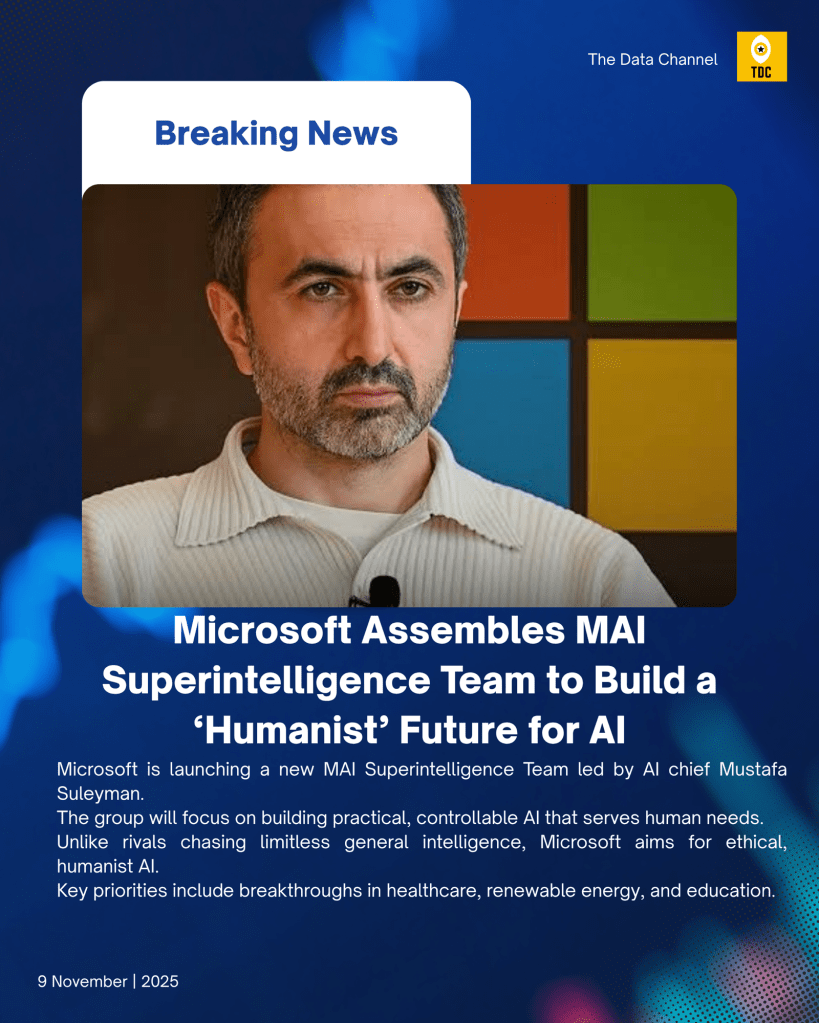
In a bold move to shape the future of advanced artificial intelligence, Microsoft has announced the creation of a new research division dedicated to superintelligence and next-generation AI systems. The initiative, called the MAI Superintelligence Team, will be led by Mustafa Suleyman, the company’s AI chief who currently oversees Bing and Copilot.
The announcement was made through a blog post by Suleyman, who emphasized that Microsoft’s approach will be guided by practicality, ethics, and human-centric values rather than speculative ambitions. “We are doing this to solve real, concrete problems and do it in such a way that it remains grounded and controllable,” he wrote. “We are not building an ill-defined and ethereal superintelligence; we are building a practical technology explicitly designed only to serve humanity.”
A Major Investment in Humanist Superintelligence
Microsoft plans to pour significant funding into the MAI Superintelligence Team, signaling the company’s deep commitment to leading the next wave of AI research. Suleyman will head the division, supported by Karen Simonyan, who has been named the team’s chief scientist. Simonyan, who worked alongside Suleyman at both DeepMind and Inflection, brings deep expertise in large-scale AI model development.
The company’s new initiative aims to take a measured, “humanist” approach to superintelligence — focusing on building systems that achieve superhuman performance in specialized areas while remaining controllable and safe. Unlike the pursuit of Artificial General Intelligence (AGI) — a theoretical system that can perform any intellectual task a human can — Microsoft’s focus will be on developing advanced, domain-specific AI tools that address pressing human challenges.
Competing in a Global AI Talent Race
The formation of the MAI Superintelligence Team comes as major technology companies intensify their competition for AI expertise. Meta recently launched its Meta Superintelligence Labs, investing billions to recruit top researchers and engineers, with signing bonuses reportedly reaching $100 million. While Suleyman did not disclose whether Microsoft plans to offer similar incentives, he confirmed that the company will recruit a mix of internal talent and external experts to build the new division.
This hiring push reflects the escalating global race to dominate the field of advanced AI. Since OpenAI released ChatGPT in 2022, tech giants have rapidly integrated generative AI into their products and platforms. Microsoft, which partnered with OpenAI early on, has woven OpenAI’s large language models into Bing, Copilot, and other applications, fundamentally transforming how users interact with software.
At the same time, OpenAI relies on Microsoft’s Azure cloud infrastructure to power its tools. Their collaboration deepened after Microsoft took a $135 billion stake in OpenAI following a recent corporate restructuring, making Microsoft both a strategic partner and a major investor in the world’s most influential AI research lab.
Reducing Dependence on OpenAI
Despite their close partnership, Microsoft is increasingly working to diversify its AI ecosystem. The company has been exploring new research partnerships and acquiring complementary AI talent to ensure independence in its future superintelligence ambitions.
A key move was the acquisition of Inflection AI, the startup co-founded by Suleyman after leaving DeepMind. Microsoft not only bought the company’s intellectual property but also hired much of its staff, effectively absorbing its research expertise. Since then, Microsoft has experimented with AI models developed by Google, Anthropic, and other startups founded by former OpenAI employees, signaling a deliberate strategy to avoid overreliance on a single AI supplier.
Through the MAI Superintelligence Team, Microsoft aims to create practical AI companions and assistants designed to help people in real-world domains such as education, healthcare, and renewable energy. Suleyman described these systems as “useful, trustworthy, and aligned with human goals,” a sharp contrast to more speculative visions of uncontrolled superintelligence.
A Different Path from Rivals
While companies like Meta and Google are pushing the boundaries of generalist AI systems, Microsoft’s new approach stands out for its emphasis on control, safety, and human purpose. Suleyman described his vision as a “humanist superintelligence” — an AI paradigm centered on serving human needs and delivering tangible societal benefits rather than chasing unlimited intelligence.
“Humanism requires us to always ask the question: does this technology serve human interests?” he wrote. According to Suleyman, the pursuit of infinitely capable generalist AI systems poses major challenges in governance and control. Instead, Microsoft’s research will focus on specialized superhuman performance in defined areas where AI can have measurable, positive impact — from optimizing energy grids to discovering new medical treatments.
He cited examples such as DeepMind’s AlphaFold, a scientific breakthrough that predicted protein structures with unprecedented accuracy, accelerating biomedical research. Microsoft hopes to replicate such success across multiple domains, using AI not as a replacement for human intelligence, but as a collaborative partner in solving the world’s most complex problems.
The Medical Frontier: Toward Expert-Level AI Diagnostics
One of the MAI Superintelligence Team’s top priorities will be advancing medical superintelligence — AI systems capable of reasoning through complex clinical problems, making expert-level diagnoses, and predicting disease progression.
Suleyman predicted that within two to three years, AI will achieve “expert-level performance across the full range of diagnostics,” capable of detecting preventable diseases earlier than current medical systems allow. These AI tools could also assist with planning and operational decision-making in hospitals, potentially transforming healthcare delivery on a global scale.
Such technology could identify subtle indicators in medical data, improve radiology interpretations, or simulate personalized treatment outcomes — making healthcare more proactive and precise. However, Suleyman emphasized that this progress must come with strong ethical guardrails. “We are not building a superintelligence at any cost, with no limits,” he wrote. “Our goal is to build AI that enhances human capability without introducing uncontrollable risks.”
Balancing Innovation and Responsibility
Microsoft’s new strategy arrives at a time when investors are increasingly questioning whether massive AI investments can yield sustainable profits. The company has spent tens of billions on cloud infrastructure, model training, and data center expansion — all to support the AI boom led by OpenAI and its Copilot suite.
Suleyman’s message seeks to reassure both investors and the public that Microsoft’s approach to superintelligence will be disciplined and focused on real-world applications, not speculative pursuits. By anchoring AI development in human needs and practical use cases, Microsoft aims to distinguish itself from rivals racing to build ever-larger and more general AI models.
This “humanist” vision marks a new phase in Microsoft’s AI journey — one rooted in responsibility, precision, and purpose. As the global AI race accelerates, Suleyman’s team will attempt to redefine what superintelligence means: not a limitless machine intellect, but a powerful, specialized, and ethical technology designed to serve humanity.
If successful, the MAI Superintelligence Team could help Microsoft not only lead in AI innovation but also shape the moral and scientific framework for the next era of intelligent systems — an era where superintelligence remains firmly under human control and deeply aligned with human values
 The DATA CHANNEL
Leave a comment