
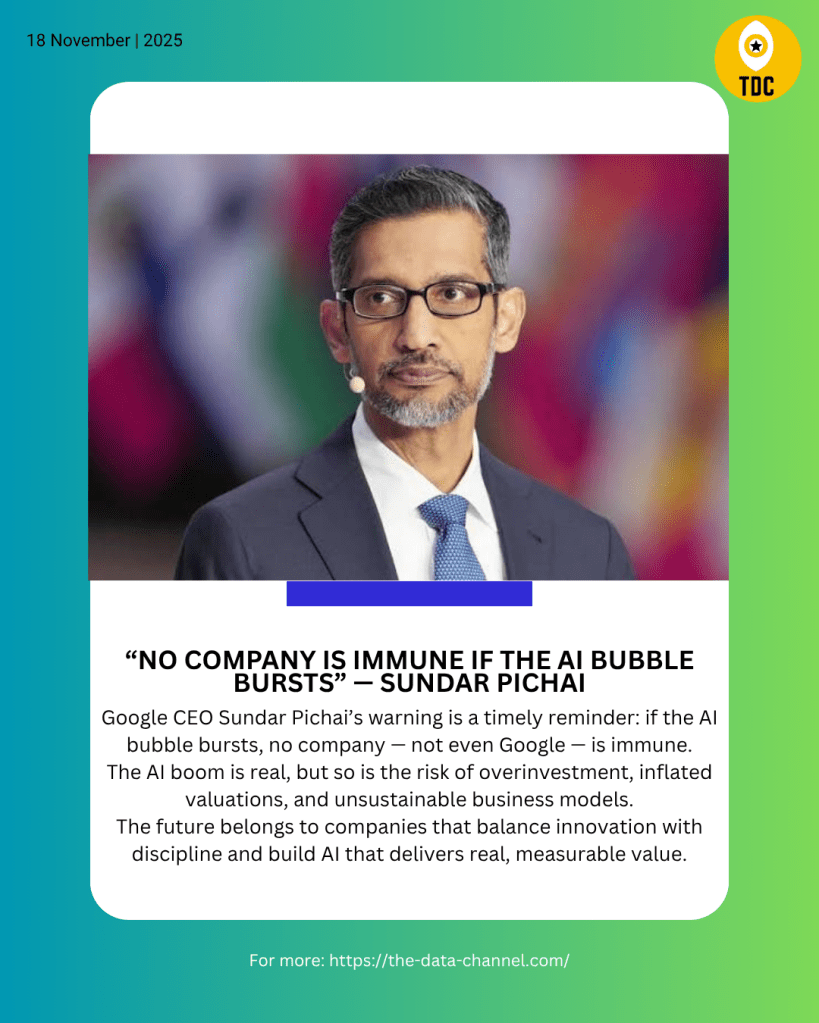
The AI boom is reshaping industries at an unprecedented pace. Companies are racing to build models, train data, deploy infrastructure, and rewrite their entire technology strategy around artificial intelligence. But amid this explosive growth, Google CEO Sundar Pichai has issued a rare and candid warning:
If the AI bubble bursts, no company will be immune — including Google itself.
His statement has sparked global discussion. Is this just cautionary leadership, or a signal that the AI frenzy has crossed into unstable territory? Let’s unpack what Pichai meant and what it means for the broader tech ecosystem.
A Boom Fueled by Innovation — and Irrationality
Pichai acknowledged that we are living through an “extraordinary moment” in AI history. The capabilities of modern models, coupled with massive advances in compute, have created real, transformative value.
But alongside the genuine progress, he also sees irrational behaviour—a level of overinvestment and speculation that mirrors early internet excesses. Venture funding is pouring into AI startups with unproven models. Tech giants are spending billions on data centers, GPUs, and energy-intensive infrastructure. Companies are branding every feature as “AI-powered” even when the business case is blurry.
Like the dot-com era, the underlying technology will survive and thrive — but the hype cycle around it could still collapse.
Why Even Big Tech Isn’t Safe
The instinctive reaction is: Surely Google can weather any AI downturn?
But Pichai’s point is simple and blunt: market corrections don’t discriminate.
If AI valuations fall sharply:
Capital will dry up Infrastructure expansion plans will slow Hiring and R&D priorities will shift Investors will demand profitability over experimentation
And big companies with the largest AI investments could feel the impact most intensely.
Pichai’s honesty here is notable — it’s rare for major tech CEOs to publicly admit their vulnerability in a hype-driven market.
The Real Risks Beneath the AI Gold Rush
1. Capital Misallocation
Tens of billions are being poured into AI with unproven revenue models. When speculation outpaces earnings, corrections become inevitable.
2. Debt-Fueled Infrastructure
Huge bets on GPUs, data centers, and energy consumption are increasingly being financed through debt — amplifying exposure if the cycle turns.
3. Unsustainable AI-First Startups
Dozens of AI companies are valued on potential rather than performance. A downturn could lead to mass consolidation or collapse.
4. Energy & Environment Pressure
Training and running large models consume enormous electricity. Rising energy costs could become a constraint — or a trigger — for a slowdown.
5. Workforce Disruption
Even as AI creates opportunity, it also adds uncertainty. Talent strategy and workforce adaptation remain unresolved.
So Is the AI Bubble Actually Real?
Opinions differ.
Some leaders see early signs of a correction.
Others, including former Google CEO Eric Schmidt, argue this is not a bubble at all — it’s a new industrial revolution driven by compute and automation.
Both can be true.
The technology is here to stay.
But the valuation cycle is volatile.
The market may need to reset before the next stable phase of growth.
What Businesses Should Do Now
Regardless of whether a bubble bursts, companies can protect themselves by focusing on fundamentals:
Invest in use cases with real ROI, not hype Scale AI gradually, not impulsively Avoid over-reliance on debt-funded infrastructure Build AI governance, security, and efficiency controls early Develop talent that understands both AI and business impact
The winners of the AI era won’t be the loudest — they’ll be the most disciplined.
A Necessary Warning, Not a Crisis
Sundar Pichai’s comments shouldn’t be seen as alarmist.
They’re a reminder that even in a transformative era, sustainable innovation matters more than short-term hype.
AI will redefine the world, just like the internet did.
But that doesn’t mean we ignore risk, or assume everyone will benefit equally.
Pichai’s message is simple:
Build with purpose. Invest with clarity. Stay grounded — even in a breakthrough moment.

 The DATA CHANNEL
Leave a comment